
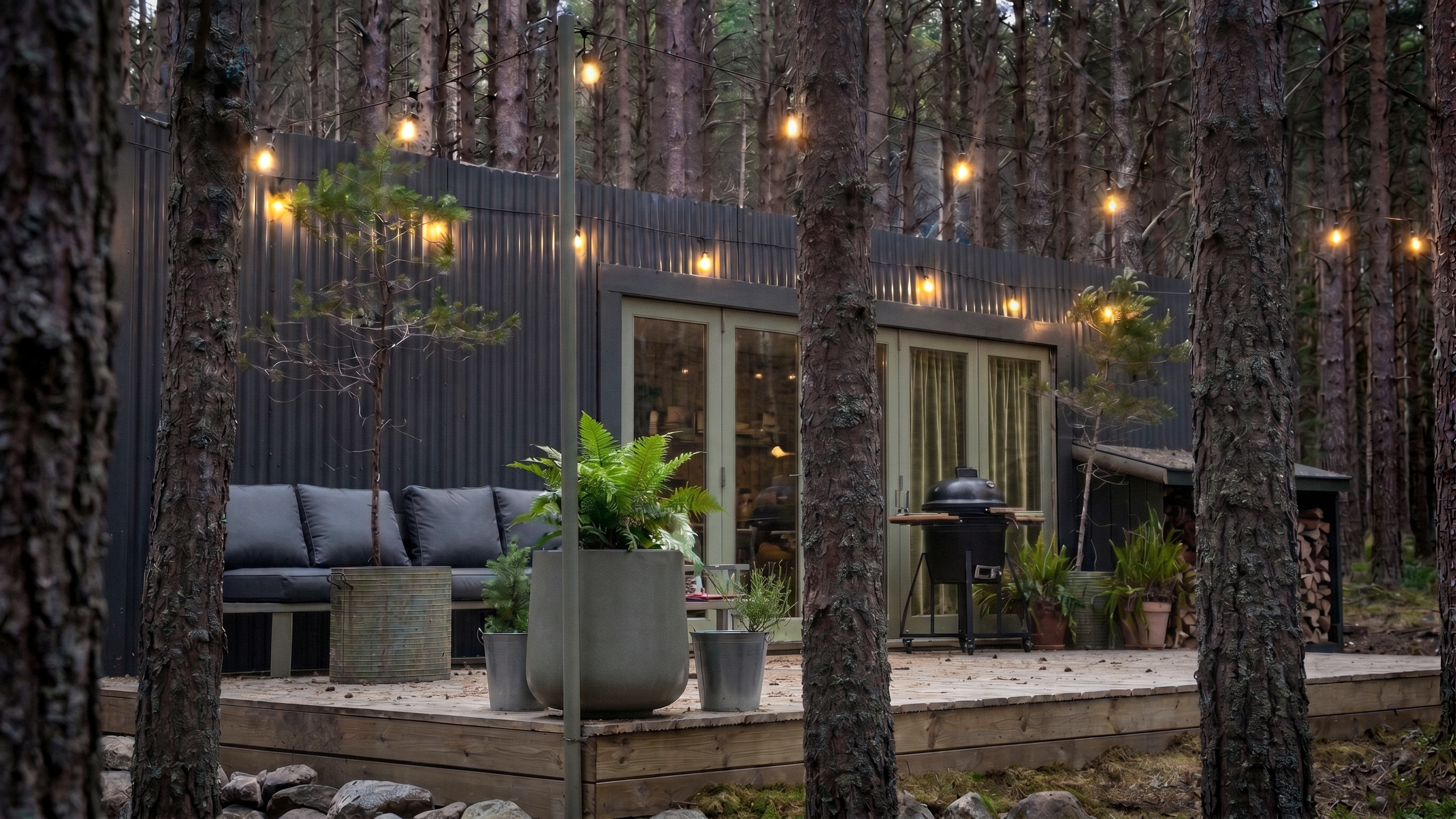
From Zero Yield to Year-Round Productivity
The Infrastructure That Unlocks Forestry
For five decades, Frontier’s Highland plantation site has had no viable economic function.
The site was locked into a standard UK forestry model: a monoculture stand, dependent on clearfell cycles, exposed to volatile commodity prices, and constrained by geography. Under current roadside timber rates of roughly £30–£35 per m³, with handling costs approaching the same level, harvesting at small or moderate scale produces no margin. In practical terms, the land was economically inactive.
This is the baseline Frontier inherited: a site with near-zero economic output, limited biodiversity, and no viable pathway to improvement under the conventional model.
The turning point was not a change in species or policy. It was infrastructure.
The Missing Layer in Forestry Economics
Remote forestry fails for a simple reason: it lacks operational infrastructure.
Without on-site facilities, every activity carries friction and cost. Tools cannot be securely stored or maintained. Workers must travel daily or rely on external accommodation. Processing cannot occur locally. Work is compressed into narrow seasonal windows. As a result, only large-scale, mechanised extraction—commodity forestry—appears viable.
This is not a biological constraint. It is an operational one.
Frontier’s response was to introduce a multi-purpose, off-grid forestry HQ: a portable, self-sufficient amenity designed to remove these constraints entirely.
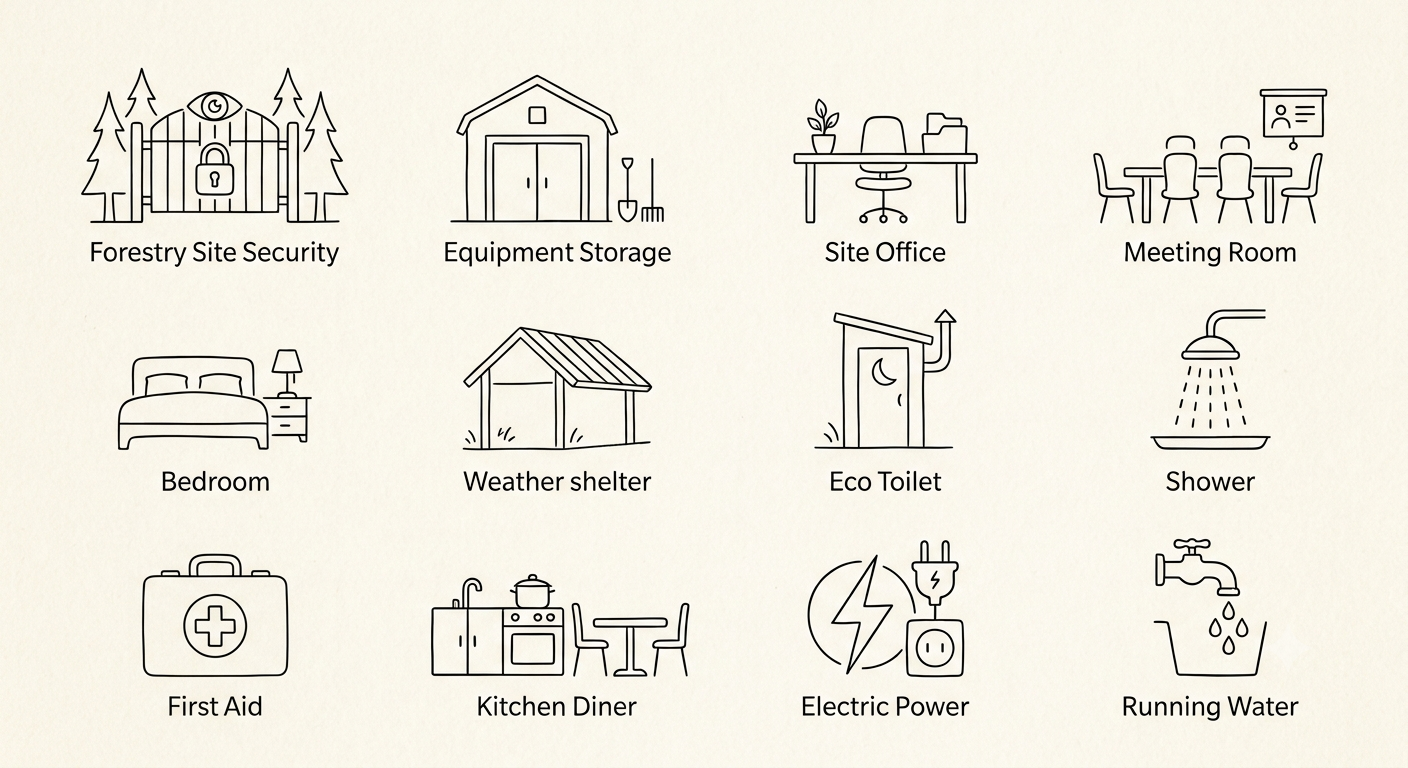
What the Frontier HQ Changes
The HQ functions as core operational infrastructure:
Secure storage and maintenance of tools and machinery on site
Office, planning, and meeting space
Welfare facilities: shelter, kitchen, sanitation, first aid
Overnight accommodation for workers and specialists
Visitor and training facility
Off-grid energy system enabling on-site processing
This is not ancillary. It is enabling.
By removing the need for travel, accommodation, and off-site dependency, the HQ reduces structural operating costs and, critically, allows work to take place continuously rather than intermittently.
Forestry on this site is no longer seasonal. It is year-round.
Quantifying the Economic Shift
The impact of infrastructure can be demonstrated at micro scale.
Consider a 5 m³ sample of Scots pine from thinning operations.
Under the conventional model (Model A):
Sale price: ~£30–£35 per m³
Handling costs: ~£30 per m³
Net outcome: approximately £0 margin
Constraint: requires large-scale extraction (e.g. ~1,000 trees) to attempt viability
At small scale, harvesting is economically irrational. The timber remains unutilised.
Under Frontier’s model (Model B), enabled by the HQ:
Timber is processed on site using local labour and portable equipment
Product is upgraded (e.g. firewood, kindling) and sold directly
25 trees from the same sample generate >£4,000 gross income
Value uplift: greater than 26x versus unprocessed sale
This is not a pricing anomaly. It is a structural shift.
The HQ makes it possible to process, store, season, and sell timber locally. Without it, none of these steps are viable.
Cost Stabilisation and Time Expansion
Two measurable changes underpin this shift:
First, cost stabilisation.
With facilities on site, fixed and variable costs are reduced and predictable. Travel, accommodation, and logistical inefficiencies are eliminated.
Second, time expansion.
Because operations are no longer constrained by logistics or weather exposure, work can be distributed across the year. This enables slower, higher-value processes such as seasoning, selective harvesting, and small-batch production.
Together, these create what is effectively “time elasticity” in forestry operations—something absent in the commodity model.
From Extraction to Enterprise
With infrastructure in place, the economic model changes fundamentally.
Instead of relying on large-scale clearfelling and external buyers, the site operates as an independent production unit:
Thinning operations become profitable rather than loss-making
Timber can be processed and sold at higher value classes
Cash flow is generated within months, not decades
Multiple revenue streams can operate simultaneously
This is the basis of economies of scope: the same infrastructure supports multiple activities, spreading costs and increasing total productivity.
The result is not incremental improvement. It is a different category of forestry business.
Ecological Impact as a Function of Viability
The ecological implications follow directly from the economics.
Under the conventional model, diversification is expensive and delayed. Restocking a monoculture plantation with mixed species can take decades and typically depends on subsidy.
Under Frontier’s model:
Profitable thinning enables selective removal of monoculture stands
Continuous cash flow funds replanting and stewardship
Mixed species (birch, cherry, rowan, alternative conifers) can be introduced progressively
Biodiversity improves as a direct outcome of economically viable management
Ecological recovery is no longer a cost centre. It is integrated into a functioning business model.
Measurable Outcomes on a Deadlocked Site
On a site previously considered uneconomic, the introduction of the HQ has already delivered:
Transition from zero productivity to year-round operations
Greater than 20x value uplift on sample timber through on-site processing
Creation of sustainable local employment
Viable small-scale harvesting where none existed before
A platform for continuous R&D and diversification
These outcomes are not theoretical. They are operational.
Why The Equipment Design Is the Breakthrough
Forestry has historically focused on biology (species, yield) and markets (timber prices), while overlooking a third variable: operational infrastructure.
Frontier’s HQ demonstrates that infrastructure is the missing layer that determines whether a site is:
Dependent or independent
Seasonal or continuous
Extractive or value-adding
Economically constrained or productive
By solving for infrastructure first, the constraints that define commodity forestry are removed.
A Replicable Model
The significance of this approach extends beyond a single site.
Many UK plantations share the same characteristics: remote locations, monoculture stands, and dependence on low-margin commodity markets. In these conditions, lack of infrastructure is a universal constraint.
The Frontier HQ model is portable and replicable. It provides a template for:
Decentralised forestry operations
Local value creation
Reduced dependency on subsidies and global pricing
Integrated ecological and economic recovery
The key insight is straightforward: forestry becomes viable at small and medium scale when infrastructure enables it
Measurable Value, Added Locally
-
A 5x uplift in baseline biodiversity is the target. Because cash flows are independent of the standard 40+ year harvesting cycle, a meaningful impact on biodiversity uplift can now be achieved within just 5 years.
Income is immediately reinvested in biodiversity uplift, creating a sustainable forestry baseline for the next generation to harvest. It is desirable, and now economic, to diversify the species mix of the plantation as we progress, precisely because we are adding real value to each tree harvested.
-
A simple question requiring some simplification to answer cleanly. A single tree = 0.2m3 material (benchmark). The difference in value potential of the same tree can be compared.
Commodity (raw material wholesale) vs Kindling (retail price).
1 tree as a ‘roadside’ round: £6 (before costs).
1 tree as kindling + peripherals: £170 (target before costs).
VALUE DIFFERENCE: 28x.
There is, in fact, more value potential available per tree than this quick example. This alone illustrates the true potential of local value uplift by processing harvested trees locally vs on an industrial scale -
By adding value to our harvest on-site and delivering kindling directly to locals on an efficient subscription basis, hundreds of miles of transport CO2 and transport costs are eliminated.
A single local delivery from Frontier, on a delivery route that serves the local community cyclically, can save as many as 800 miles of road haulage per customer, vs the same customer purchasing kindling via Tesco’s industrial distribution system. -
Frontier kindling creates sustainable new jobs. Local talent is invested in because there is 20x potential value in training and employing talent.
Adding value to each tree locally transforms the economic potential of each tree. The value potential of the plantation itself changes with this.
The entire value chain is centred around maximising local benefits; turning what we have into high value, rather than depending on industrial scale, and selling trees at just £5/unit.
-
Each tree must be sustainable ecologically, as Frontier’s first principle. There are different ways to measure at this.
Job sustainability is viable at <200 trees (harvested) per job per year.
Frontier can also afford to replace each pine harvested with mountain ash, birch, wild cherry (or any number of other native species) to boost biodiversity, without waiting 40 years to generate ROI. Each tree produces enough value locally for its replacement.
-
This is the antithesis of the standard 40+ year commodity forestry harvest cycle because it works on a rolling-investment basis.
There is now a measurable direct return on investment (per tree, per year) that measurably benefits local wildlife and local customers immediately.
-
By investing in innovation, including efficient new processes, and technology, and by investing local talent, the otherswise unproductive land is producing measurable value on a sustainable footing, year round.