
Frontier Kindling: Value-Added Forestry in Practice
Commodity forestry runs on scale, uniformity, and clearfelling. Frontier does the opposite: we create more value from every single tree, at lower volumes, distributed locally, and we use that value to actively restore the land we harvest.
The Economics of Value-Add
A £6 wholesale tree becomes £156 of retail kindling, bark, and bulk once we process it on site. That is a 26x uplift in value per tree, achieved not through volume but through vertical integration: taking a raw material that would otherwise leave the site as an undifferentiated commodity, and finishing it locally with our own people and technology. The income this generates funds the one thing commodity forestry cannot afford to do: diversify the plantation instead of clearing it. Frontier by contrast, maintains evergreen cover and diversifies progressively.
Why Local Supply Matters
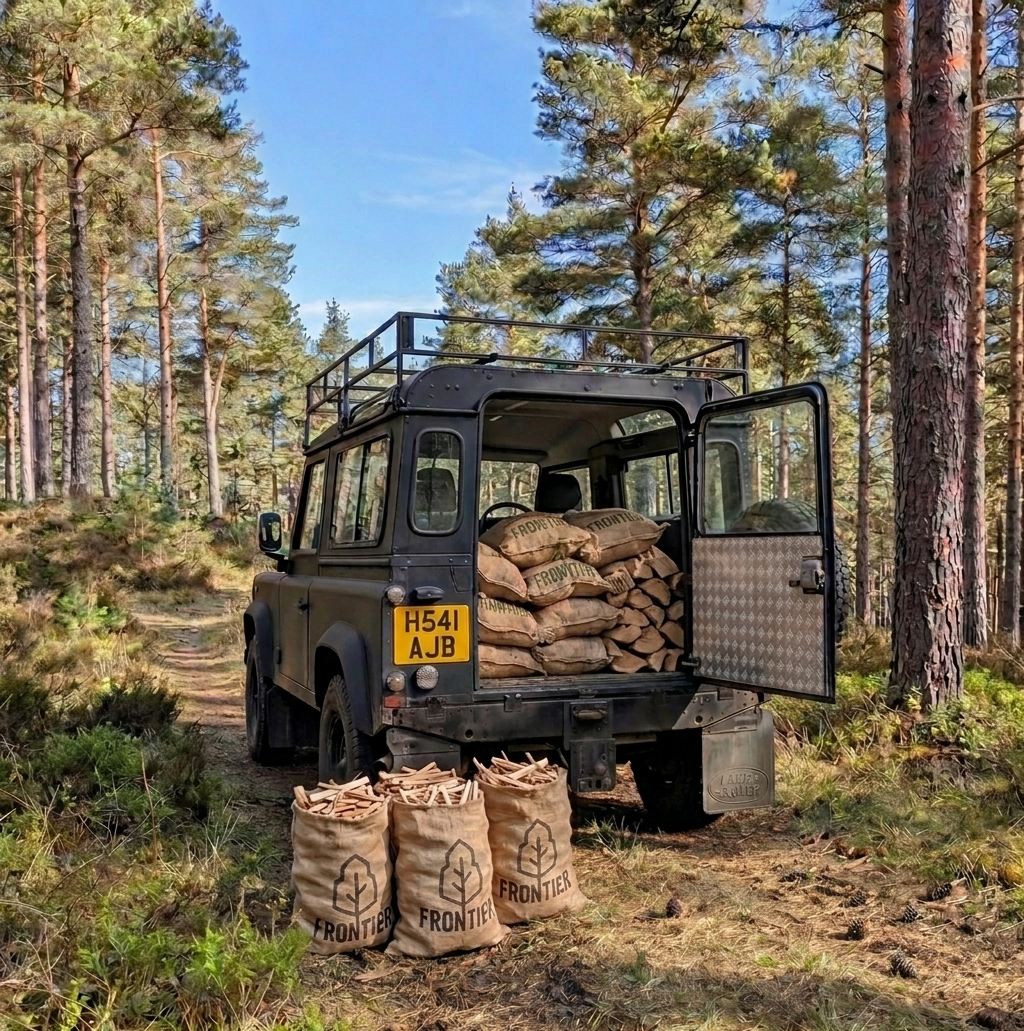
Thousands of Highland homes heat with a stove or open fire, buying kindling that has typically travelled hundreds of miles through three or more haulage legs from industrial suppliers. A single bag of Frontier Kindling can save 800km of that road transport. We are not asking customers to choose between better value and a better environmental outcome; our subscription model, delivered direct from forest to fireplace, gives them both at once.
From Monocrop to Polycrop, Tree by Tree
Our pilot site in Carrbridge is a single-species plantation, the product of post-war planting optimised purely for extraction. Rather than clearfell it on a 40-year cycle, we thin it strategically, tree by tree, and reinvest the proceeds in new species. Our target is a 5x increase in tree species diversity alongside that 25x increase in value per tree, transforming this plantation site into a 5-species stand over time. Every bag sold effectively pays for the introduction of new species into the plantation, richer habitat for pollinators, wildflowers, insects, birds, and mammals that a dense monocrop cannot support.
A Different Kind of Productivity
Commodity forestry is defined by long dormant periods punctuated by a single disruptive extraction event. Frontier's model replaces that with continuous, on-site processing: year-round work, year-round cash flow, and no clearfelling shock to the land. This is what makes the plantation an economically productive asset, rather than a site sitting idle until the next 40-year reckoning.
The Business Model
Frontier Kindling is a direct-to-consumer supply business operating from the plantation itself, built to outcompete supermarket and forecourt kindling on price, carbon footprint, and customer experience through a subscription delivery model. We take on the upfront investment in people and technology, and spread that risk over a sustainable income stream, because the alternative, an unprocessed, undiversified plantation, is economically dormant.
The Principle
Value-add forestry is not a trade-off between commercial return and ecological repair; it is the mechanism by which one funds the other. By maximising the value we create locally from each tree, we generate the cash needed to progressively rebalance what a single-species plantation cannot sustain on its own, without shocks, and without waiting forty years to start. It creates new jobs, balances forests progressively, and adds value locally
Measurable Value, Added Locally
-
A 5x uplift in baseline biodiversity is the target. Because cash flows are independent of the standard 40+ year harvesting cycle, a meaningful impact on biodiversity uplift can now be achieved within just 5 years.
Income is immediately reinvested in biodiversity uplift, creating a sustainable forestry baseline for the next generation to harvest. It is desirable, and now economic, to diversify the species mix of the plantation as we progress, precisely because we are adding real value to each tree harvested.
-
A simple question requiring some simplification to answer cleanly. A single tree = 0.2m3 material (benchmark). The difference in value potential of the same tree can be compared.
Commodity (raw material wholesale) vs Kindling (retail price).
1 tree as a ‘roadside’ round: £6 (before costs).
1 tree as kindling + peripherals: £170 (target before costs).
VALUE DIFFERENCE: 28x.
There is, in fact, more value potential available per tree than this quick example. This alone illustrates the true potential of local value uplift by processing harvested trees locally vs on an industrial scale -
By adding value to our harvest on-site and delivering kindling directly to locals on an efficient subscription basis, hundreds of miles of transport CO2 and transport costs are eliminated.
A single local delivery from Frontier, on a delivery route that serves the local community cyclically, can save as many as 800 miles of road haulage per customer, vs the same customer purchasing kindling via Tesco’s industrial distribution system. -
Frontier kindling creates sustainable new jobs. Local talent is invested in because there is 20x potential value in training and employing talent.
Adding value to each tree locally transforms the economic potential of each tree. The value potential of the plantation itself changes with this.
The entire value chain is centred around maximising local benefits; turning what we have into high value, rather than depending on industrial scale, and selling trees at just £5/unit.
-
Each tree must be sustainable ecologically, as Frontier’s first principle. There are different ways to measure at this.
Job sustainability is viable at <200 trees (harvested) per job per year.
Frontier can also afford to replace each pine harvested with mountain ash, birch, wild cherry (or any number of other native species) to boost biodiversity, without waiting 40 years to generate ROI. Each tree produces enough value locally for its replacement.
-
This is the antithesis of the standard 40+ year commodity forestry harvest cycle because it works on a rolling-investment basis.
There is now a measurable direct return on investment (per tree, per year) that measurably benefits local wildlife and local customers immediately.
-
By investing in innovation, including efficient new processes, and technology, and by investing local talent, the otherswise unproductive land is producing measurable value on a sustainable footing, year round.