

Frontier Forestry Off-Grid Energy Tech R&D
Frontier Forestry is advancing a new model for woodland management; one that integrates enterprise, technology, and ecological responsibility to redefine what forestry can achieve.
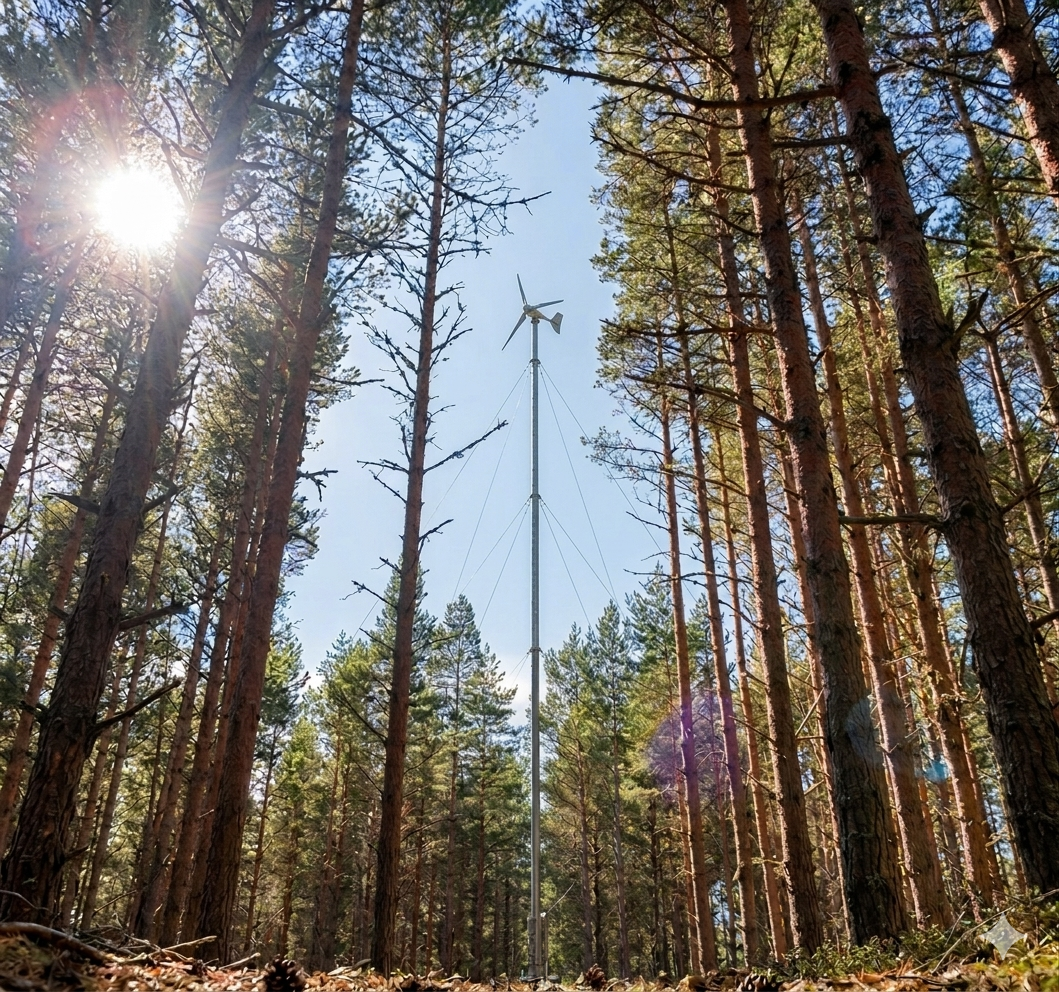
Frontier’s Off-Grid Energy Tech R&D is an example of technical innovation with big potential
At the heart of this work is a practical challenge: how to power operations in remote environments without compromising the land itself. Through ongoing research and development, Frontier is demonstrating that clean, decentralised energy systems can be deployed in ways that are both economically viable and environmentally invisible.
A key innovation is the development of a lightweight, pop-up wind energy system designed specifically for forestry conditions. This modular mast assembly can be rapidly installed and removed without leaving any trace, preserving the integrity of the woodland while providing a reliable on-site power source. Positioned above the tree line, the turbine captures wind energy efficiently, generating up to 2 kW/h; sufficient to support tools, equipment, and a growing range of electrically powered forestry applications.
This approach represents more than a technical solution; it signals a shift in how forestry operations are conceived. Traditional commodity forestry has often been constrained by fixed infrastructure, external energy dependence, and narrow economic margins. Frontier’s model, by contrast, embraces flexibility and self-sufficiency. By harvesting clean energy directly within the woodland, operations become more resilient, less carbon-intensive, and capable of supporting diversified activities that were previously impractical.
The system has undergone multiple design iterations to refine its performance, portability, and minimal impact profile. The result is a robust yet unobtrusive solution that aligns with Frontier’s broader objective: to demonstrate that forestry can evolve into a high-functioning, multi-dimensional enterprise. By combining scientific insight, engineering innovation, and commercial discipline, Frontier is contributing to a future where productive forestry and ecological stewardship are not competing priorities, but mutually reinforcing outcomes.
In this way, Frontier Forestry is not simply adapting to the energy transition—it is actively shaping how that transition can be implemented on the ground. The integration of micro-scale, clean energy systems opens new pathways for sustainable land use, enabling forestry to operate with a level of precision, autonomy, and environmental sensitivity that far exceeds conventional expectations.