

Emergency Water Systems
The Dava fire and Cairngorm fire of summer 2026 are a warning shot for every forest manager in the Highlands about the risk of fire. Alongside this, foresters must now contend with risk of prolonged drought, caused by climate change.
The Climate Change Committee’s A Well-Adapted UK report makes clear that the UK must prepare for more severe wildfire conditions as hotter temperatures, lower soil moisture and longer fire seasons become more common.
Frontier Forestry has made water resilience a core part of its response.
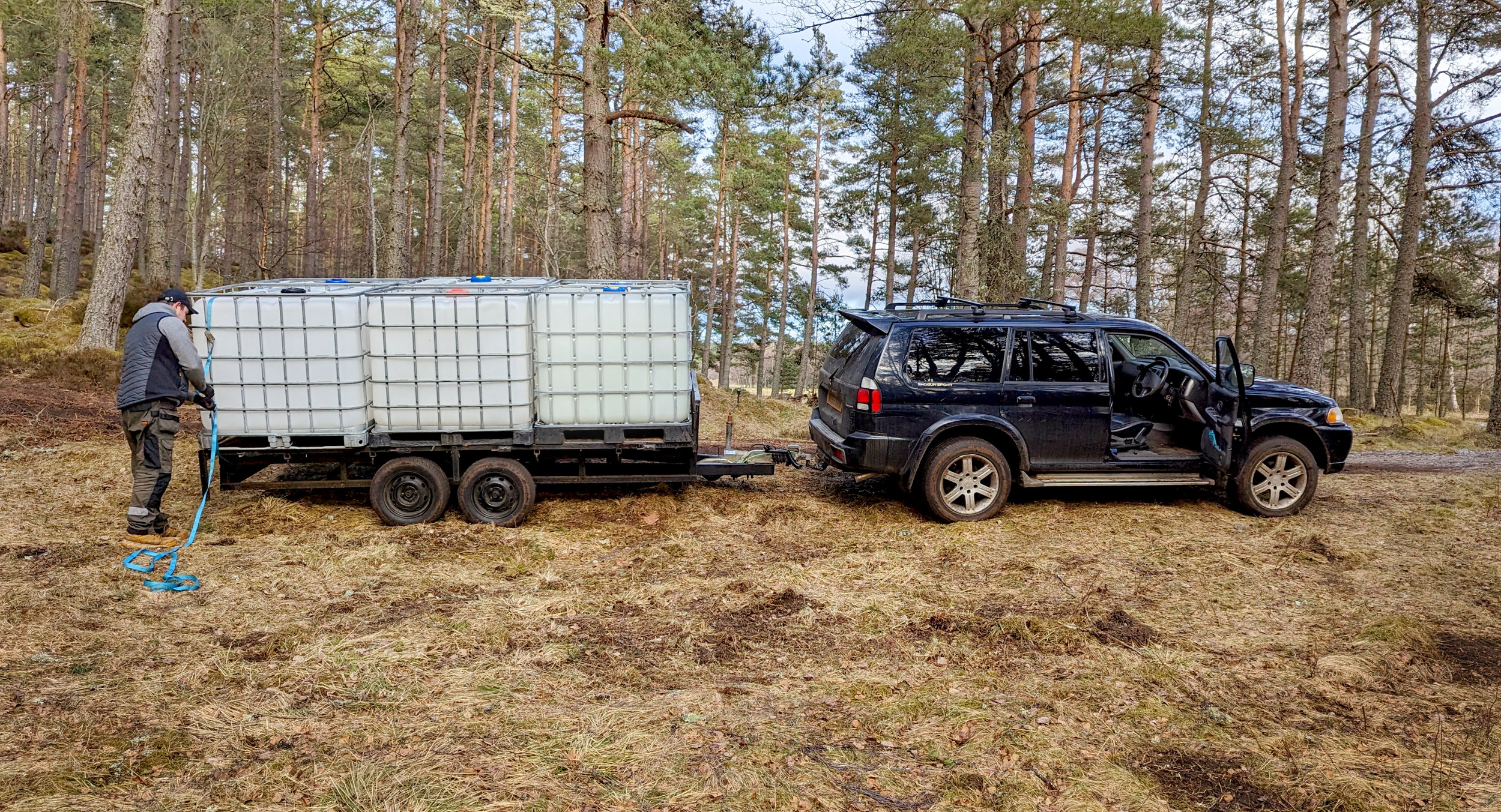
We are fortunate to have access to abundant running water on site for most of the year. Through systemic design, we can transform this natural asset into functional resilience by using modular storage and designing off-grid water distribution to function under stressful conditions. In an emergency, Frontier can distribute many tons of water quickly. This builds local resilience, enhancing and perhaps avoiding the need for external fire service support. The system can also provide moisture to the trees during a period of drought, so sustainability is maintained by design and a system that is easy to execute.
Baroness Brown, chair of the CCC’s Adaptation Committee, has stressed that proven technologies are available now to help the UK adapt effectively. Frontier’s view is that forestry should take that message literally: if wildfire is becoming a routine operational risk, then water storage, pumping and access must be designed into the landscape in advance rather than improvised during a crisis.
At Frontier’s pilot site near Carrbridge, that thinking has already been turned into a working prototype.
A modular water storage and distribution system has been set up to allow rapid deployment without waiting for fire trucks, with water collected and stored during the wettest months so it is available when the landscape is driest. This creates one independent line of protection on site, built around anticipation rather than reaction.
The second line of protection is access. Following advice from Fire Services, poorly maintained historic forest access tracks have been improved so that movement around the site is faster, safer and more reliable in an emergency. Forest Research identifies infrastructure such as roads, rides and water resources as a key part of resilience because access routes, passing places and suitable water sources directly affect response times and suppression capability during wildfire incidents.
Together, these measures create two independent ways to manage a crisis: water where it is needed, and access to get people and equipment into position quickly. That matters because resilient systems should not rely on a single point of success. If one route, pump or method fails, another must still be available.
This is also why Frontier has developed two parallel pumping systems. One allows electric pumping and the other hydrocarbon-powered pumping, so the site is not dependent on a single energy source during a live incident. In practical terms, this is about engineering out avoidable vulnerability. It is the same principle that underpins good wildfire planning more broadly: remove single points of failure, shorten response times, and make suppression possible early, before a manageable ignition becomes a landscape-scale fire.
The innovation story here is not only about protecting one site. It is about engineering modular, portable kits and testing systems that can be replicated elsewhere at realistic cost. The CCC’s adaptation report argues for practical measures that can be deployed now, while Forest Research has emphasised the value of demonstration activity and knowledge exchange so that adaptive practice can spread across the forestry sector. Frontier’s model fits that logic: prototype on the ground, test under real conditions, refine the design, and then share the blueprint.
That approach matters in wildfire because no estate is truly protected in isolation. The Dava fire showed that risk flows across landscapes. A fire that begins on moorland can threaten forests, access routes, neighbouring properties and communities within hours. The most useful innovations, therefore, are not those that remain proprietary and enclosed, but those that can be distributed. Portable water storage, modular pumping, practical track improvements and documented response systems can all be adapted by other land managers in Scotland without requiring prestige budgets or specialist infrastructure.
This is where Frontier Forestry sees its role. Not simply to comment on climate adaptation, but to build it. Baroness Brown and the CCC have highlighted the scale of the challenge and the urgency of acting now. Frontier’s answer is to treat wildfire preparedness as an engineering problem that can be solved strategically: anticipate the weak points, remove redundancy risks, create portable systems, and make the benefits replicable.
The lesson from Dava is not only that wildfire is now a defining management issue for the uplands. It is also that practical preparation is possible.